I started to write poetry at the age of eleven and I have continued to do so for decades till today, having survived both breast cancer and the pandemic.
A few years ago, aging and a gradual and sudden worsening of my physiological condition hit me very hard. I thought I would give up poetry and writing altogether and seek refuge in gardening.
Poetry called me. I attended the Jaipur Literary Festival 2025 with my son Toshu . He followed me out of love.
I realized how a fortunate mother I was when I slipped and fell under the shower and Toshu rushed to my rescue. Diagnosed with severe injuries in the right shoulder, I spent the rest of my stay in Jaipur in a hotel room bed with a quill and with the passion of my life, my poetry.
Reading loud from my book of short poems Leaves cc. Anita Bacha.
Many thanks for spending some of your precious time with me, dear friends and readers.
I am glad to announce that I have just added a new release to my repertoire –
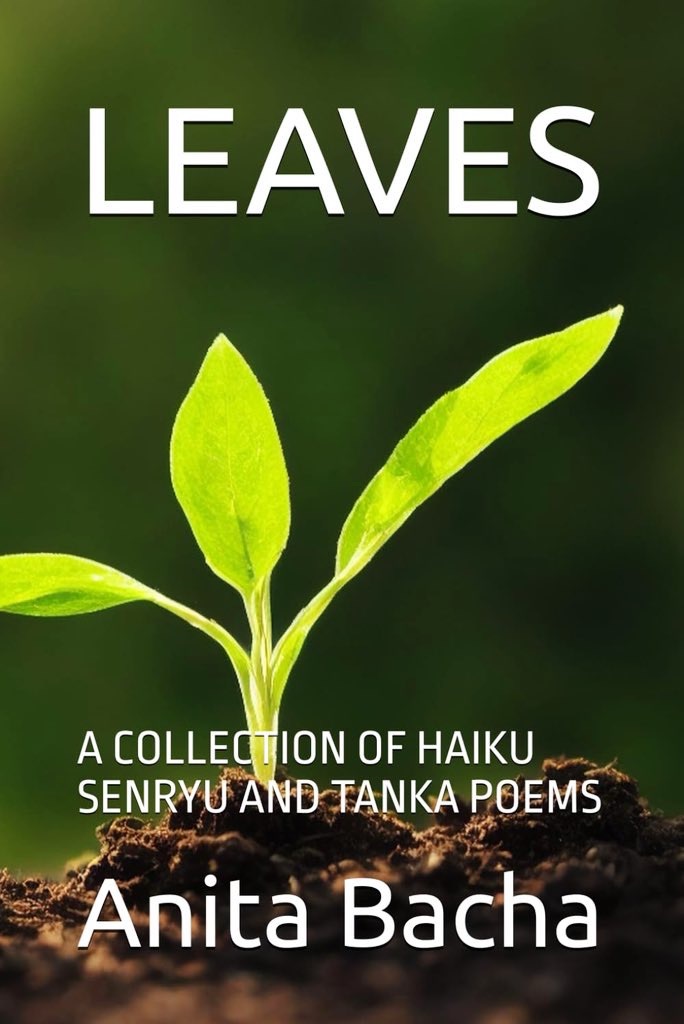
LEAVES
It’s a collection of short poems,namely haiku,senryu and tanka written fondly with you in mind.
I picked up my quill after a long illness to compile this collection of haiku, senryu and tanka poems which, has been a major part of my recovery.Writing every day, no thrice a day, is my secret potion. On a naughty note, I wanted to prove to my ophthalmologist that writing won’t make me blind.
What is Leaves about?
Choosing a title for a poetry book is not an easy task especially when it comes to a collection of short poems.
One morning, I was gazing at the overcast sky when a yellow leaf fell at my feet, followed by another, yet another. Deeply marveled and inspired by Mother Nature’s cycle of life, I have named my new collection of short poems, LEAVES. Each poem molded, shaped, colored differently is a leaf from Mother Nature’s Notebook.
This collection of traditional and modern haiku, senryu and tanka is divided in three parts. The first one consists of haiku unfolding the four seasons of the year, starting with summer and ending with winter. The second comprises senryu and, the third and last one includes tanka.
Haiku is a Japanese poem of traditionally seventeen syllables in three, short, unrhymed lines. Nature themes and imagery evoking a specific season of the year are the traditional focus of haiku poetry.
Haiku developed from the hokku, the opening lines of a longer poem known as tanka, an ancient form of poetry that consists of 5 lines in a 5/7/5/7/7 syllables count form. The tanka poem is traditionally about seasons, nature and emotions. Senryu is another short form Japanese poetry similar to haiku in construction with three lines and seventeen syllables count. Senryu, however, tend to be about human foibles; they are often cynical and darkly humorous. Haiku is more serious.
Whereas traditional haiku and senryu poets observe strictly the 5/7/5 syllables pattern, modern poets try different syllables count and formats to achieve a more minimalist style.







 Anita Bacha